


102 Exam Questions for CAMS-FCI Updated Versions With Test Engine
Pass CAMS-FCI Exam with Updated CAMS-FCI Exam Dumps PDF 2024
NEW QUESTION # 18
Potential indicators of money laundering associated with Trust and Company Service Providers include:
(Select Two.)
- A. multi-jurisdictional wire transfers with no legal purpose.
- B. frequent deposits to or withdrawals from bank accounts.
- C. structuring cash deposits into third party accounts.
- D. use of legal persons in jurisdictions with strict secrecy laws.
- E. generation of rental income to legitimize illicit funds.
Answer: A,D
Explanation:
Explanation
This is stated in the Certified Anti-Money Laundering Specialist (the 6th edition) manual on page 595, which states: "Potential indicators of money laundering associated with Trust and Company Service Providers include the use of legal persons in jurisdictions with strict secrecy laws, structuring cash deposits into third party accounts, multi-jurisdictional wire transfers with no legal purpose, and frequent deposits to or withdrawals from bank accounts."
NEW QUESTION # 19
SAR/STR NARRATIVE
A SAR/STR has been submitted on five transactions conducted on the correspondent banking relationship with ABC Bank.
Client Information:
Remitter information: DEF Oil Resource Ltd. is the oldest member of the DEF Group. It was founded in 1977 as a general trading business with a primary focus on exports from Africa and North America. The group has business activities that span the entire energy value chain. Their core field of endeavor is centered within the oil and gas industry and its associated sub-sectors.
Beneficiary Information:
As per the response received from ABC Bank, it was determined that the beneficiaries are related to DEF Oil Resource Ltd. These were created by DEF Oil Resource Ltd. to purchase property in a foreign country on behalf of their senior management as part of a bonus scheme. The purpose behind this payment was for the purchase of property in another country.
Payment Reference:
ABCXXXXX31PZFG2H
ABCXXXXXX51PQGEH
ABCXXXXXX214QWVG
ABCXXXXXX41PSXA2
ABCXXXXXX815QWS3
Concerns:
* We are unsure about the country of incorporation of the beneficiaries.
* We are concerned about the transactional activity since the payment made towards entities (conducted on behalf of individuals) appears to be possible tax evasion.
* There appears to be an attempt to conceal the identity of individuals (senior management), which again raises concerns about the source of funds.
* Referring to the response received from ABC Bank, we are unclear about the ultimate beneficiary of funds.
* The remitter is involved in a high-risk business, (i.e., oil and crude products trading), and the beneficiary is involved in real estate business which again poses a higher risk.
When drafting the SAR/STR narrative, the investigator notes several payment references. What additional information should the investigator include in the narrative?
- A. The investigator's concerns based on their subjective opinion
- B. The suspicious accounts and transactions identified
- C. Personal tax records pertinent to the owners to indicate tax evasion
- D. All relevant tables, spreadsheets, and other supporting documentation
Answer: B
Explanation:
Explanation
The SAR/STR narrative should include the suspicious accounts and transactions identified, as well as the reasons why they are considered suspicious. The narrative should provide a clear and concise description of the activity, the parties involved, the dates, amounts, and frequencies of the transactions, and any other relevant information that would assist law enforcement in understanding the nature and purpose of the activity.
The narrative should not include the investigator's subjective opinion, personal tax records, or supporting documentation that is not essential to explain the suspicious activity. Supporting documentation can be attached separately to the SAR/STR form or provided upon request by law enforcement.
NEW QUESTION # 20
A retail bank prepares a yearly AML risk assessment. Which inherent risk factor is likely the most relevant?
- A. The provision of brokerage services
- B. The provision of cash services
- C. The provision of payable through accounts
- D. The provision of remote check deposit services
Answer: B
Explanation:
Explanation
Retail banks typically have a high inherent risk of money laundering due to their provision of cash services.
This is because cash is a preferred medium of exchange for criminals and terrorists, and retail banks provide a convenient way for them to move large sums of money without detection. Retail banks are also vulnerable to money laundering through the use of false identities and other deceptive practices. (CAMS Manual, 6th Edition, Page 8).
NEW QUESTION # 21
Each month the automated transaction monitoring system generates alerts based on predetermined scenarios.
An alert was generated in relation to the account activity of ABC Foundation. Below is the transaction history for ABC Foundation (dates are in DD/MM/YYYY format).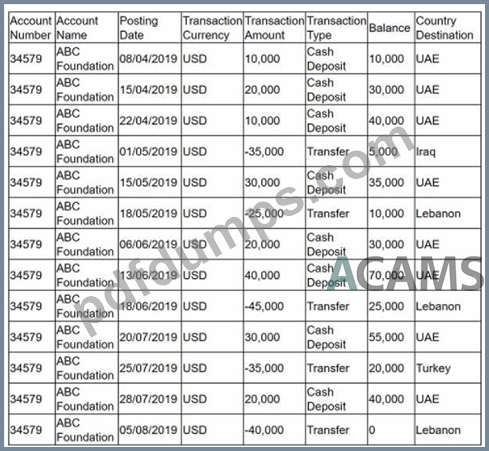
The relationship manager for ABC Foundation contacts the client to request more information on the beneficiary of the transfer in Turkey. ABC Foundation advises that this is a not-for-profit charity group called
'Forever Free." Which is the best next step in the investigation?
- A. Update the customer profile to include Forever Free as the recipient of the funds.
- B. Contact the financial institution in Turkey that has a relationship with Forever Free and advise them of the investigation.
- C. Check the junsdiction's list of known chanties with connections to terrorist activity.
- D. File a SAR/STR with the new information learned about the beneficiary.
Answer: C
Explanation:
Explanation
The best next step in the investigation is to check the jurisdiction's list of known charities with connections to terrorist activity . This is because the FI has a responsibility to verify the legitimacy and reputation of the beneficiary of the funds, especially if it is a charity or non-profit organization that operates in a high-risk jurisdiction or sector. According to the ACAMS Advanced Financial Crimes Investigations Certification Study Guide1, "the FI should conduct enhanced due diligence on all parties involved in the investigation, including checking various sources of information, such as watch lists, sanctions lists, negative news, and official registries" (p. 24). The FI should also check if the beneficiary is consistent with the customer's profile and expected activity.
The other options are not as appropriate or effective as option C.
Contacting the financial institution in Turkey that has a relationship with Forever Free and advising them of the investigation (A) could violate confidentiality or data protection laws, as well as compromise the investigation or alert the customer or beneficiary of the suspicion. Updating the customer profile to include Forever Free as the recipient of the funds (B) could be premature or inaccurate, as it does not verify the nature and purpose of the transfer or the identity and legitimacy of the beneficiary. Filing a SAR/STR with the new information learned about the beneficiary (D) could also be premature or incomplete, as it does not confirm if there is any suspicious or criminal activity involved in the transfer or if there are any other red flags or indicators.
NEW QUESTION # 22
An investigator at a corporate bank is conducting transaction monitoring alerts clearance.
KYC profile background: An entity customer, doing business offshore in Hong Kong, established a banking business relationship with the bank since 2017 for deposit and loan purposes. It acts as an offshore investment holding company. The customer declared that the ongoing source of funds to this account comes from group-related companies.
* X is the UBO. and owns 97% shares of this entity customer;
* Y is is the authorized signatory of this entity customer. This entity customer was previously the subject of a SAR/STR.
KYC PROFILE
Customer Name: AAA International Company. Ltd
Customer ID: 123456
Account Opened: June 2017
Last KYC review date: 15 Nov 2020
Country and Year of Incorporation: The British Virgin Islands, May 2017 AML risk level: High Account opening and purpose: Deposits, Loans, and Trade Finance Anticipated account activities: 1 to 5 transactions per year and around 1 million per transaction amount During the investigation, the investigator reviewed remittance transactions activities for the period from Jul
2019 to Sep 2021 and noted the following transactions pattern:
TRANSACTION JOURNAL
Review dates: from July 2019 to Sept 2021
For Hong Kong Dollars (HKD) currency:
Incoming transactions: 2 inward remittances of around 1.88 million HKD in total from different third parties Outgoing transactions: 24 outward remittances of around 9 4 million HKD in total to different third parties For United States Dollars (USD) currency:
Incoming transactions: 13 inward remittances of around 3.3 million USD in total from different third parties Outgoing transactions: 10 outward remittances of around 9.4 million USD in total to different third parties.
RFI Information and Supporting documents:
According to the RFI reply received on 26 May 2021, the customer provided the bank with the information below:
1J All incoming funds received in HKD & USD currencies were monies lent from non-customers of the bank.
Copies of loan agreements had been provided as supporting documents. All of the loan agreements were in the same format and all the lenders are engaged in trading business.
2) Some loan agreements were signed among four parties, including among lenders. borrower (the bank's customer), guarantor, and guardian with supplemental agreements, which stated that the customer, as a borrower, who failed to repay a loan Which suspicious activity should the investigator identify during the review of the loan agreements?
- A. Y signed on behalf of the lenders.
- B. Y is the authorized signatory on the beneficial ownership form.
- C. AAA International Company Ltd.'s account has transactions in HKD and USD.
- D. Online information found that X is the chairman of a business group of companies.
Answer: A
Explanation:
Explanation
The correct answer is D because it is a suspicious activity that Y, who is the authorized signatory of the customer, also signed on behalf of the lenders. This indicates a possible conflict of interest, collusion, or fraud.
The other options are not suspicious activities based on the information given.
References: [Advanced CAMS-FCI Study Guide], page 17-18
NEW QUESTION # 23
CLIENT INFORMATION FORM Client Name: ABC Tech Corp Client ID. Number: 08125 Name: ABC Tech Corp Registered Address: Mumbai, India Work Address: Mumbai, India Cell Phone: "**"'" Alt Phone:
"*""* Email: ........"
Client Profile Information:
Sector: Financial
Engaged in business from (date): 02 Jan 2020 Sub-sector: Software-Cryptocurrency Exchange Expected Annual Transaction Amount: 125,000 USD Payment Nature: Transfer received from clients' fund Received from: Clients Received for: Sale of digital assets The client identified itself as Xryptocurrency Exchange." The client has submitted the limited liability partnership deed. However, the bank's auditing team is unable to identify the client's exact business profile as the cryptocurrency exchange specified by the client as their major business awaits clearance from the country's regulator. The client has submitted documents/communications exchanged with the regulator and has cited the lack of governing laws in the country of their operation as the reason for the delay.
During the financial crime investigation, the investigator discovers that some of the customer due diligence (CDD) documents submitted by the client were fraudulent. The investigator also finds that some of the information in the financial institution's information depository is false. What should the financial crime investigator do next?
- A. Request that the relationship manager conduct a CDD refresh as it is a material trigger.
- B. Report collusion between the cryptocurrency exchange and internal staff in the internal hotline or whistle-blowing channel.
- C. Escalate to the compliance officer/money laundering reporting officer to file a SAR/STR.
- D. Contact the client directly and obtain the relevant notarized documents and information.
Answer: C
Explanation:
Explanation
The correct answer is C. Escalate to the compliance officer/money laundering reporting officer to file a SAR/STR. This is because the financial crime investigator has found evidence of fraudulent documents and false information, which indicate a high risk of money laundering or other financial crimes. The investigator should not contact the client directly, as this may tip them off or compromise the investigation. The investigator should also not report collusion between the cryptocurrency exchange and internal staff, as this is an assumption that has not been verified. The investigator should not request a CDD refresh, as this is not sufficient to address the serious issues identified.
References:
Advanced CAMS-FCI Study Guide, page 291
Advanced CAMS-FCI Study Guide, page 311
Advanced CAMS-FCI Study Guide, page 331
1: https://www.acams.org/en/certifications/advanced-cams/advanced-financial-crimes-investigations
NEW QUESTION # 24
Due to an ever-diversifying business model and multi-jurisdictional footprint, a casino has decided to outsource the source of funds and wealth checks to a third-party provider. Why is it important for the casino to maintain control of the output from the provider?
- A. Clients of the casino prefer to know that the casino is keeping their information secure when being held by a third-party.
- B. The casino maintains ultimate responsibility for this activity and should maintain control to avoid non-compliance.
- C. Other casinos are frequently looking to reduce costs and share ideas, so if this relationship is successful, the model can be used by other businesses.
- D. As with all third-party relationships, proper control must be maintained to ensure profitability.
Answer: B
Explanation:
Explanation
The reason why it is important for the casino to maintain control of the output from the provider is that the casino maintains ultimate responsibility for this activity and should maintain control to avoid non-compliance
. This is because the casino is accountable for its own AML/CFT obligations and cannot delegate or outsource them to a third-party provider. According to the ACAMS Advanced Financial Crimes Investigations Certification Study Guide1, "the FI should ensure that it has adequate oversight and control over any third-party providers that it engages for AML/CFT purposes, such as conducting due diligence, verifying information, or monitoring transactions" (p. 25). The FI should also "review and evaluate the performance and quality of the third-party providers on a regular basis, and address any issues or gaps that may arise" (p. 25).
The other options are not as relevant or accurate as option C. The clients of the casino prefer to know that the casino is keeping their information secure when being held by a third-party (A) is not a reason why the casino should maintain control of the output from the provider, but rather a customer expectation or preference. As with all third-party relationships, proper control must be maintained to ensure profitability (B) is not a reason why the casino should maintain control of the output from the provider, but rather a general business principle or objective. Other casinos are frequently looking to reduce costs and share ideas, so if this relationship is successful, the model can be used by other businesses (D) is not a reason why the casino should maintain control of the output from the provider, but rather a potential benefit or outcome.
NEW QUESTION # 25
An analyst reviews an alert for high volume Automated Clearing House (ACH) activity in an account. The analyst's initial research finds the account is for a commercial daycare account that receives high volumes of large government-funded ACH transactions to support the programs. The account activity consists of checks (cheques) made payable to individual names in varying dollar amounts. One check indicates rent to another business.
An Internet search finds that the daycare company owner has previous government-issued violations for safety and classroom size needs, such as not having enough chairs and tables per enrollee. These violations were issued to a different daycare name.
Simultaneous to this investigation, another analyst sends an email about negative news articles referencing local child/adult daycare companies misusing governmental grants. This prompts the financial institution (Fl) to search all businesses for names containing daycare' or "care*. Text searches return a number of facilities as customers at the Fl and detects that three of these businesses have a similar transaction flow of high volume government ACH funding with little to no daycare expenses.
During the investigation, new suspicious patterns and trends related to check cashing are observed. The Fl decides to conduct a training to ensure that 1) the AML program is robust and 2) the training program is relevant and appropriate. Which parties should be trained on emerging trends and red flags? (Select Two.)
- A. The board of directors
- B. Financial crimes investigation unit
- C. Senior management
- D. Loan department
- E. Branch personnel
Answer: B,E
Explanation:
Explanation
The parties that should be trained on emerging trends and red flags are the financial crimes investigation unit (A) and the branch personnel . These parties are directly involved in detecting, investigating, and reporting suspicious activity related to check cashing or other types of fraud or money laundering. According to the ACAMS Advanced Financial Crimes Investigations Certification Study Guide1, "the FI should provide regular and relevant training to its staff on the AML program, policies, procedures, and systems, as well as on the latest typologies, indicators, and best practices for financial crimes investigations" (p. 36). The FI should also "ensure that the training is tailored to the specific roles and responsibilities of the staff, and that it is updated and evaluated periodically" (p. 36).
The other parties are not as relevant or appropriate as options A and C. The loan department (B) is not directly related to check cashing or other types of fraud or money laundering, although it may have some exposure to credit or identity fraud. The senior management (D) is responsible for overseeing and supporting the AML program, but not for conducting or supervising financial crimes investigations. The board of directors (E) is responsible for approving and reviewing the AML program, but not for implementing or monitoring it.
References: 1: ACAMS Advanced Financial Crimes Investigations Certification Study Guide, available at ACAMS
NEW QUESTION # 26
An unusual spike in activity has occurred for a customer who is a supplier of aviation parts to a military force.
The customer's current line of business is consistent with the banks records, and no adverse media hits have occurred. Which is the best reason for an investigator to continue an investigation?
- A. The current line of business is consistent with the bank's records.
- B. The customer is a supplier of aviation parts.
- C. The end-user is a military force.
- D. There are no adverse media hits.
Answer: C
Explanation:
Explanation
The best reason for an investigator to continue an investigation is that the end-user is a military force. This is because supplying aviation parts to a military force may involve sanctions risk, export control risk, or human rights risk, depending on the nature and destination of the military force. The investigator should conduct further due diligence to determine if the customer is complying with the relevant laws and regulations, and if the bank is exposed to any reputational or legal risk by providing services to the customer.
References:
Former Airline Employee and Aircraft Part Sellers Charged in Kickback ...
Former Airline Employee and Aircraft Part Sellers Charged in Kickback ...
Former airline employee and aircraft part sellers charged in kickback ...
NEW QUESTION # 27
The compliance learn is reviewing multiple data points to include in its data analytics program to detect shell or front company red flags. Which data points should the compliance team include? (Select Two.)
- A. Entities transacting with or having relation to tax haven or high-risk countries
- B. Entities exhibiting transactions with declared counterparties
- C. Entities whose principal place of business is a non-residential address
- D. Entities with a large number and variety of beneficiaries not declared at the time of onboarding
- E. Entities with high paid-up capital relative to monthly value of transactions
Answer: A,C
Explanation:
Explanation
The data points that the compliance team should include in its data analytics program to detect shell or front company red flags are entities whose principal place of business is a non-residential address and entities transacting with or having relation to tax haven or high-risk countries. These data points may indicate that the entities are not conducting legitimate business activities, but rather are used to conceal the identity or location of the true beneficiaries or owners, or to facilitate money laundering, tax evasion, or other illicit activities.
Some of the sources that support these data points as red flags are4567:
Entities whose principal place of business is a non-residential address may indicate that they have no physical presence, operations, assets, or employees. They may use addresses such as post office boxes, mail forwarding services, registered agents, or virtual offices to avoid detection or scrutiny.
Entities transacting with or having relation to tax haven or high-risk countries may indicate that they are involved in offshore financial activities that are designed to evade taxes, regulations, or sanctions. They may also be exposed to higher risks of money laundering, terrorist financing, corruption, or fraud.
References:
How to Identify a Shell Company and the Associated Red Flags
Difference between Shell, Shelf & Front Company | Sigma Ratings
Shell Companies and Money Laundering | ComplyAdvantage
General Comments Incorporation of shell companies - Singapore Police Force
NEW QUESTION # 28
A client at a financial institution deposits large amounts of money into an account, and almost immediately, the funds are then distributed to numerous individuals' accounts. The transaction activity described in the scenario is a pattern of:
- A. account usage.
- B. safe deposit custody.
- C. geographic usage.
- D. deposit trading.
Answer: D
Explanation:
Explanation
Deposit trading is a pattern of suspicious activity where a client deposits large amounts of money into an account, and then transfers the funds to other accounts, often in different jurisdictions or countries. This could be an attempt to disguise the source or destination of the funds, or to avoid reporting requirements. Deposit trading is also known as layering, which is the second stage of money laundering.
References: ACAMS Advanced Financial Crimes Investigations Certification Study Guide, page 43; ACAMS Glossary, page 34.
NEW QUESTION # 29
Law enforcement (LE) suspects human trafficking to occur during a major spotting event. LE officers asked several financial institutions (FIs) to monitor financial transactions occurring before, during, and after the event.
An investigator identified a pattern linked to a business. The business* account received multiple even dollar deposits between midnight and 4:00 AM. They occurred each day for several days prior to the date of the sporting event. Also, large cash deposits, typically between 2,000 USD and 3.000 USD. made by a person to the business' account occurred in many branches in the days after the sports event There was little information about the company. The company did not have any history of employee payroll expenses or paying taxes. Expenses from the business account included air travel and hotel expenses. Searches about the person making cash deposits showed little. An online social media platform webpage with the individual's name showed ads for dates" and "companionship." If the investigator uncovers evidence that foreign nationals are involved in this activity, they should also note the possible presence of:
- A. human smuggling.
- B. black market peso exchange.
- C. tax fraud.
- D. trade-based laundering.
Answer: A
Explanation:
Explanation
If the investigator uncovers evidence that foreign nationals are involved in this activity, they should also note the possible presence of human smuggling (D). This is because human smuggling is the illegal movement of people across borders, often facilitated by criminal networks that exploit vulnerable migrants. According to the FATF and Egmont Group report on Financial Flows from Human Trafficking2, "human smuggling can be closely linked to human trafficking, as smuggled migrants may become victims of trafficking along their journey or at their destination" (p. 9). The report also states that some indicators of human smuggling are similar to those of human trafficking, such as:
Frequent cash deposits or withdrawals in different locations
Use of false or fraudulent identification documents
Expenses related to travel and accommodation
Involvement in online platforms that advertise sexual services
The other options are not as relevant or specific as option D.
Tax fraud (A) is the evasion of taxes by individuals or businesses, which may or may not be related to human trafficking or smuggling. Black market peso exchange (B) is a money laundering scheme that involves exchanging illicit proceeds in one currency for another currency at a discounted rate, which is more commonly associated with drug trafficking or trade-based laundering. Trade-based laundering is the manipulation of trade transactions to disguise the origin and ownership of illicit funds, which is also more likely to be linked to drug trafficking or other types of fraud.
References: 1: ACAMS Advanced Financial Crimes Investigations Certification Study Guide, available at ACAMS 2: FATF and Egmont Group, Financial Flows from Human Trafficking, July 2018, available at FATF
NEW QUESTION # 30
A client that runs a non-profit organization that aids refugees in leaving their home countries received a remittance from a money services business that was ten times the average. The client was recently detained for providing falsified passports to illegal immigrants. Which predicate offenses could be considered in the SAR/STR? (Select Two.)
- A. Human smuggling/trafficking
- B. Antiques smuggling
- C. Narcotics trafficking
- D. Terrorist financing
- E. Tax evasion
Answer: A,D
Explanation:
Explanation
The correct answer is A and B because human smuggling/trafficking and terrorist financing are both predicate offenses for money laundering that could be related to the client's activities. Option C is incorrect because there is no indication of narcotics trafficking in the scenario. Option D is incorrect because there is no indication of antiques smuggling in the scenario. Option E is incorrect because there is no indication of tax evasion in the scenario.
References: Advanced CAMS-FCI Certification Handbook, page 10; Financial Crime Typologies - Intermediate Certificate, Module 2.
NEW QUESTION # 31
A national financial intelligence unit (FIU) is undertaking the country risk assessment for the financing of the proliferation of weapons of mass destruction (WMD). The evaluation involves determining the exposure that financial institutions (FIs) have to operations that evade sanctions. Which should be performed by the FIU to assess proliferation financing risk? (Select Two.)
- A. Cross-reference the databases of international commerce/logistics transactions between the country and WMD proliferation sanctioned states with the corresponding international financial operations of those transactions.
- B. Prepare new regulations that increase fines for FIs that allow financial operations on behalf of WMD proliferation sanctioned states.
- C. Compare the international finance operations with national PEP lists to determine if the systems used by FIs are properly calibrated to detect WMD proliferation financing.
- D. Analyze the domestic financial operations that are above the reporting threshold and have similar names to high-level officials of WMD proliferation sanctioned states.
- E. Evaluate a sample of the amount of false-positive and false-negative alerts that FIs have regarding proliferation sanctions evasion to determine root causes of non-detection.
Answer: A,E
Explanation:
Explanation
The FIU should cross-reference the databases of international commerce/logistics transactions between the country and WMD proliferation sanctioned states with the corresponding international financial operations of those transactions, as this would help identify any discrepancies or anomalies that could indicate sanctions evasion. The FIU should also evaluate a sample of the amount of false-positive and false-negative alerts that FIs have regarding proliferation sanctions evasion to determine root causes of non-detection, such as inadequate screening systems, lack of training, or human error. These actions would help the FIU assess the proliferation financing risk and provide feedback and guidance to FIs on how to improve their detection and prevention capabilities.
References: Advanced CAMS-FCI Study Guide, page 32-33; [FATF Guidance on Counter Proliferation Financing], page 15-16.
NEW QUESTION # 32
During transaction monitoring. Bank A learns that one of their customers. Med Supplies 123, is attempting to make a payment via wire totaling 382,500 USD to PPE Business LLC located in Mexico to purchase a large order of personal protective equipment. specifically surgical masks and face shields. Upon further verification.
Bank A decides to escalate and refers the case to investigators.
Bank A notes that, days prior to the above transaction, the same customer went to a Bank A location to wire
1,215,280 USD to Breath Well LTD located in Singapore. Breath Well was acting as an intermediary to purchase both 3-ply surgical masks and face shields from China. Bank A decided not to complete the transaction due to concerns with the involved supplier in China. Moreover, the customer is attempting to send a third wire in the amount of 350,000 USD for the purchase of these items, this time using a different vendor in China. The investigator must determine next steps in the investigation and what actions, if any. should be taken against relevant parties.
Upon further investigation. Bank As investigator learns that both the Mexico- and Singapore-based companies are linked to the alleged suppliers in China. Which additional indicators would the investigator need to identify to determine if this fits a fentanyl (drug) trafficking typology? (Select Two.)
- A. Review of the account activity reveals that account is inconsistent with the expected business activity as it shows multiple charges at various hotels, transportation tickets for unrelated 3rd parties, etc.
- B. Review of the Food and Drug Administration (FDA) product certifications provided by the customer reveals that documents were falsified.
- C. Review of the account activity reveals that wires were mainly funded by multiple cash deposits, conducted in amounts of 10.000 USD or below.
- D. Review of the invoices and transportation documents, provided by the customer, reveal significant discrepancies between the description of goods.
Internet research reveals that suppliers are newly established companies with no history of sales of medical equipment.
Answer: B,D
NEW QUESTION # 33
The investigative department of a financial institution (Fl) receives an internal escalation notice from the remittance department for a SWIFT message requesting a refund due to potential fraud. The notice indicates that a total of three international incoming remittances were transferred to a corporate customer from Country A, in the amount of approximately 5 million EUR for each. The first two incoming remittances had been exchanged into currency B and transferred out to Country B a few days ago. The third incoming remittance has been held by the remittance department.
As noted from the KYC profile, the corporate customer is working in the wood industry. with the last account review completed 3 months ago. Since the account's opening. there has been no history of a large amount of funds flowing through the account. The investigator conducts an Internet search and finds that the remitter is a food beverage company.
The same morning, the investigator receives a call from a financial intelligence unit (FIU) inquiring about the same incident. The FIU states that it will issue a warrant to freeze the account on the same day.
Which steps for documenting the final investigation decision are appropriate for the investigator in this scenario?
- A. Add all of the information the Fl has about the subject, their account(s) activity, research results. KYC information, etc. to the SAR/STR.
- B. Exclude any open-source information from record-keeping since it is publicly available.
- C. Do not document the investigation process if a SAR/STR is not filed.
- D. Document the investigation process and retain all relevant documents in the case management system.
Answer: D
Explanation:
Explanation
The investigator should document the investigation process and retain all relevant documents in the case management system. This is because documenting the investigation process is a good practice to ensure the quality and consistency of the investigation, as well as to facilitate the review and audit of the investigation.
Retaining all relevant documents is also important to support the evidence and findings of the investigation, as well as to comply with the record-keeping requirements of the relevant authorities. The other options are incorrect because:
A: Excluding any open-source information from record-keeping is not advisable, as open-source information can provide valuable insights and context for the investigation, and may not be easily retrievable in the future.
B: Adding all of the information the FI has about the subject, their account(s) activity, research results, KYC information, etc. to the SAR/STR is not necessary, as the SAR/STR should only contain the essential information that is relevant and material to the suspicious activity. Adding too much information may obscure the main points and make the SAR/STR less effective.
D; Not documenting the investigation process if a SAR/STR is not filed is not acceptable, as the investigation process should be documented regardless of the outcome. Documenting the investigation process can help justify why a SAR/STR was not filed, and also provide a reference for future investigations involving the same subject or activity.
R:ferences:Advanced CAMS-FCI Certification | ACAMS, Section 3: Reporting Suspicious Activity, page 14 Leading Complex Investigations Certificate | ACAMS, Module 4: Documenting Your Investigation, page 4
NEW QUESTION # 34
A bank investigator notices an account receiving multiple deposits from the same employer under different employees' names. A cash withdrawal occurs one day after each deposit. The outcome of this investigation will likely uncover which crime typology?
- A. Bribery and corruption
- B. Trade-based money laundering
- C. Environmental
- D. Human trafficking
Answer: A
Explanation:
Explanation
The correct answer is A because this scenario describes a possible case of human trafficking, which is a crime where people are exploited for labor or sexual services against their will. Human traffickers may use bank accounts to launder their proceeds and pay their victims, and they may use fake or stolen identities to avoid detection. The other options are not likely because they do not explain why multiple deposits from the same employer under different employees' names would occur, nor why cash withdrawals would follow each deposit.
References: : Human Trafficking, : Human Trafficking Red Flags
NEW QUESTION # 35
Which actions should financial institutions perform to ensure proper data governance? (Select Three.)
- A. Periodically validate integrity and accuracy of information used for IT systems such as customer information, customer identification records, and transaction records.
- B. Review significant discrepancies between the values of the product reported on the invoice and the fair market value.
- C. Ensure the accuracy of customer identification records and transaction records and appropriately manage data as a prerequisite for the effective use of IT systems.
- D. For customers who are determined to be at high risk, review their risk rating and apply risk mitigation measures as appropriate.
- E. Evaluate the nature of foreign remittance under a risk-based structure of AML/CFT and take necessary measures in accordance with the risk-based approach.
- F. Establish an appropriate data management method for collecting and storing information.
Answer: A,C,F
Explanation:
Explanation
Financial institutions should perform the following actions to ensure proper data governance:
Establish an appropriate data management method for collecting and storing information. This is important to ensure that the data is consistent, reliable, and accessible for various purposes, such as risk assessment, compliance reporting, and customer service. Data management methods may include defining data standards, policies, and procedures; implementing data quality controls and validation checks; and using appropriate data storage systems and formats.
Ensure the accuracy of customer identification records and transaction records and appropriately manage data as a prerequisite for the effective use of IT systems. This is important to comply with the anti-money laundering and counter-terrorist financing (AML/CFT) requirements, such as customer due diligence, transaction monitoring, and suspicious activity reporting. Accurate and complete customer and transaction data also enables financial institutions to use IT systems more effectively for data analysis, risk management, and decision making.
Periodically validate integrity and accuracy of information used for IT systems such as customer information, customer identification records, and transaction records. This is important to ensure that the data remains up-to-date, relevant, and reliable over time. Data validation may include verifying the source and quality of the data; identifying and correcting any errors or inconsistencies; and updating or deleting any obsolete or redundant data.
References:
Data Governance for Financial Institutions - Capgemini
Small and Medium-Sized Deposit-Taking Institutions (SMSBs) Capital and Liquidity Requirements - OSFI
NEW QUESTION # 36
Law enforcement (LE) suspects human trafficking to occur during a major spotting event. LE officers asked several financial institutions (FIs) to monitor financial transactions occurring before, during, and after the event.
An investigator identified a pattern linked to a business. The business* account received multiple even dollar deposits between midnight and 4:00 AM. They occurred each day for several days prior to the date of the sporting event. Also, large cash deposits, typically between 2,000 USD and 3.000 USD. made by a person to the business' account occurred in many branches in the days alter the sports event.
There was little information about the company. The company did not have any history of employee payroll expenses or paying taxes. Expenses from the business account included air travel and hotel expenses. Searches about the person making cash deposits showed little. An online social media platform webpage with the individual's name showed ads for dates" and "companionship." Which fact should not be included in (he SAR/STR narrative?
- A. The time of the cash deposits
- B. The request by law enforcement
- C. The air travel and hotel expenses
- D. The sporting event
Answer: A
Explanation:
Explanation
The fact that should not be included in the SAR/STR narrative is the request by law enforcement (D). This is because the request by law enforcement is confidential and should not be disclosed to the customer or anyone else who is not authorized to know it. According to the ACAMS Advanced Financial Crimes Investigations Certification Study Guide1, "the FI should not include any reference to the LE request in the SAR/STR narrative, as this could compromise the LE investigation or alert the customer of the suspicion" (p. 35). The FI should also not inform the customer of the LE request or delay filing the SAR/STR because of it.
The other facts should be included in the SAR/STR narrative, as they are relevant and indicative of human trafficking money laundering. The air travel and hotel expenses (A) show that the customer is involved in moving people across different locations, which could be a sign of human smuggling or trafficking. The time of the cash deposits (B) shows that the customer is receiving cash payments during unusual hours, which could be a sign of illicit activities or services. The sporting event shows that the customer is exploiting a high-demand situation for their business, which could be a sign of opportunistic or organized crime.
NEW QUESTION # 37
In a SAR/STR narrative concerning Individual A. which statement indicates a product of analysis rather than a fact or judgement?
- A. Individual A made structured cash deposits possibly to circumvent regulatory reporting requirements
- B. Individual A made structured cash deposits on almost consecutive days.
- C. Individual A was the originator of nine wires totaling 225.000 USD between January and March 2020.
- D. Individual A is a college student and employed part-time at a car wash.
Answer: A
Explanation:
Explanation
A product of analysis is a conclusion or inference that is derived from facts or judgments, using analytical techniques or tools. Option B is a product of analysis because it implies that the investigator has used a tool or technique, such as a threshold analysis, to identify a pattern of structured cash deposits that may indicate an attempt to evade reporting requirements. The other options are facts or judgments that can be verified by evidence or observation.
References: Advanced CAMS-FCI Certification Handbook, page 23.
NEW QUESTION # 38
Which action is part of the enhanced due diligence process?
- A. Applying higher ownership percentage requirement for beneficial ownership collection
- B. Verifying the source of wealth for entities and natural person clients
- C. Collecting beneficial ownership details regarding the client's account
- D. Using standard monitoring procedures to monitor transactions and account activity
Answer: C
Explanation:
Explanation
One of the actions that is part of the enhanced due diligence process is collecting beneficial ownership details regarding the client's account. This is important to identify the natural persons who ultimately own or control the client, and to assess the potential risks associated with them. According to the Financial Action Task Force (FATF), beneficial ownership information should include1:
The name, nationality, and country of residence of each beneficial owner.
The date of birth or incorporation of each beneficial owner.
The nature and extent of the beneficial interest held by each beneficial owner.
The means by which the beneficial ownership or control is exercised.
References:
FATF Guidance on Transparency and Beneficial Ownership
NEW QUESTION # 39
......
CAMS-FCI Exam Dumps - Free Demo & 365 Day Updates: https://studyguide.pdfdumps.com/CAMS-FCI-valid-exam.html