


[Aug 02, 2026] Get Free Updates Up to 365 days On Developing SPLK-3001 Braindumps
Best Quality Splunk SPLK-3001 Exam Questions
NEW QUESTION # 22
When investigating, what is the best way to store a newly-found IOC?
- A. Click the "Add IOC" button.
- B. Click the "Add Artifact" button.
- C. Add it in a text note to the investigation.
- D. Paste it into Notepad.
Answer: B
Explanation:
Using the "Add Artifact" button ensures that the IOC is stored in a structured and searchable manner within the investigation, facilitating better tracking and analysis.
NEW QUESTION # 23
When installing Enterprise Security, what should be done after installing the add-ons necessary for normalizing data?
- A. Configure the add-ons via the Content Management dashboard.
- B. Disable the add-ons until they are ready to be used, then enable the add-ons.
- C. Nothing, there are no additional steps for add-ons.
- D. Configure the add-ons according to their README or documentation.
Answer: D
Explanation:
https://docs.splunk.com/Documentation/ES/6.4.1/Install/Planyourdatainputs
NEW QUESTION # 24
In order to include an event type in a data model node, what is the next step after extracting the correct fields?
- A. Visit the CIM dashboard.
- B. Save the settings.
- C. Run the correct search.
- D. Apply the correct tags.
Answer: D
Explanation:
Explanation
In order to include an eventtype in a data model node, you need to apply the correct tags to the eventtype. Tags are labels that you can assign to event types to identify them as belonging to a specific category or domain.
Tags are used by data models to map event types to data model nodes. For example, if you have an eventtype named windows_performance that contains events related to Windows performance metrics, you can tag it with performance and os. Then, you can include the eventtype in a data model node that matches those tags, such as the Performance node in the Operating System data model12. To apply tags to an eventtype, you can use the Settings > Event types page in Splunk Web, or the eventtypes.conf and tags.conf configuration files3.
References = 1: About data models - Splunk Documentation - How data models use tags. 2: Use tags to map event types to data model nodes - Splunk Documentation. 3: About event types - Splunk Documentation - Tag event types.
NEW QUESTION # 25
If a username does not match the 'identity' column in the identities list, which column is checked next?
- A. Nickname
- B. Email.
- C. Combination of Last Name, First Name.
- D. IP address.
Answer: D
NEW QUESTION # 26
Who can delete an investigation?
- A. The investigation owner and collaborators.
- B. ess_admin users only.
- C. The investigation owner only.
- D. The investigation owner and ess-admin.
Answer: B
Explanation:
Explanation/Reference: https://docs.splunk.com/Documentation/ES/6.1.0/Admin/Manageinvestigations
NEW QUESTION # 27
After data is ingested, which data management step is essential to ensure raw data can be accelerated by a Data Model and used by ES?
- A. Applying Tags.
- B. Extracting Fields.
- C. Normalization to the Splunk Common Information Model.
- D. Normalization to Customer Standard.
Answer: C
NEW QUESTION # 28
Which Splunk ES feature automatically prioritizes notable events by predefined security risk scores?
- A. Data model acceleration improves search speed across indexed enterprise datasets.
- B. Asset and identity correlation enriches events with contextual organizational metadata.
- C. Adaptive response actions trigger automated remediation after notable event generation.
- D. Risk-based alerting calculates cumulative entity risk from correlated detections.
Answer: D
Explanation:
Risk-based alerting aggregates risk modifiers from multiple detections, helping analysts prioritize entities showing suspicious patterns instead of investigating isolated low-priority alerts individually.
NEW QUESTION # 29
What kind of value is in the red box in this picture?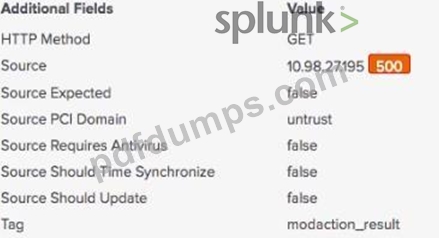
- A. A source ranking.
- B. An IP address rating.
- C. An event priority.
- D. A risk score.
Answer: D
NEW QUESTION # 30
What does the Security Posture dashboard display?
- A. Active investigations and their status.
- B. A high-level overview of notable events.
- C. A display of the status of security tools.
- D. Current threats being tracked by the SOC.
Answer: B
Explanation:
Explanation
The Security Posture dashboard is designed to provide high-level insight into the notable events across all domains of your deployment, suitable for display in a Security Operations Center (SOC). This dashboard
NEW QUESTION # 31
What kind of value is in the red box in this picture?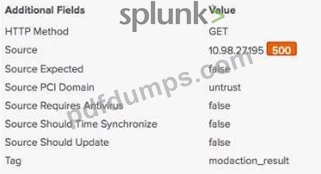
- A. A source ranking.
- B. A risk score.
- C. An IP address rating.
- D. An event priority.
Answer: D
Explanation:
Explanation/Reference: https://docs.splunk.com/Documentation/Splunk/8.0.2/Data/FormateventsforHTTPEventCollector
NEW QUESTION # 32
How is it possible to navigate to the list of currently-enabled ES correlation searches?
- A. Settings -> Searches, Reports, and Alerts -> Filter by Name of "Correlation"
- B. Configure -> Content Management -> Select Type "Correlation" and Status "Enabled"
- C. Settings -> Searches, Reports, and Alerts -> Select App of "SplunkEnterpriseSecuritySuite" and filter by "-Rule"
- D. Configure -> Correlation Searches -> Select Status "Enabled"
Answer: B
Explanation:
This path allows you to filter and view only the correlation searches that are currently enabled in the Enterprise Security (ES) module.
NEW QUESTION # 33
How should an administrator add a new lookup through the ES app?
- A. Add the lookup file to /etc/apps/SplunkEnterpriseSecuritySuite/lookups
- B. Upload the lookup file using Configure -> Content Management -> Create New Content -> Managed Lookup
- C. Upload the lookup file in Settings -> Lookups -> Lookup table files
- D. Upload the lookup file in Settings -> Lookups -> Lookup Definitions
Answer: B
Explanation:
Reference:
https://docs.splunk.com/Documentation/ES/6.1.0/Admin/Createlookups
NEW QUESTION # 34
When investigating, what is the best way to store a newly-found IOC?
- A. Click the "Add Artifact" button.
- B. Click the "Add IOC" button.
- C. Add it in a text note to the investigation.
- D. Paste it into Notepad.
Answer: B
NEW QUESTION # 35
Which component enriches security events with business context about systems and users?
- A. Data model acceleration improves correlation search execution using summarized datasets.
- B. Threat intelligence framework stores indicators collected from external intelligence providers.
- C. Search head clustering distributes scheduled searches across multiple synchronized members.
- D. Asset and identity framework maps organizational systems and associated identities.
Answer: D
Explanation:
The asset and identity framework enriches events with ownership, category, priority, and user details, enabling more accurate investigation and correlation activities.
NEW QUESTION # 36
Which of the following is a risk of using the Auto Deployment feature of Distributed Configuration Management to distribute indexes.conf?
- A. Indexes might crash.
- B. Indexes have different settings.
- C. Indexes might be processing.
- D. Indexes might not be reachable.
Answer: A
Explanation:
Reference:
https://docs.splunk.com/Documentation/Splunk/8.0.2/Admin/Indexesconf
NEW QUESTION # 37
Which of the following would allow an add-on to be automatically imported into Splunk Enterprise Security?
- A. A prefix of CIM_
- B. A suffix of .spl
- C. A prefix of TECH_
- D. A prefix of Splunk_TA_
Answer: D
Explanation:
https://dev.splunk.com/enterprise/docs/developapps/enterprisesecurity/planintegrationes/
NEW QUESTION # 38
The Remote Access panel within the User Activity dashboard is not populating with the most recent hour of data.
What data model should be checked for potential errors such as skipped searches?
- A. Performance
- B. Authentication
- C. Web
- D. Risk
Answer: B
Explanation:
https://docs.splunk.com/Documentation/ES/6.6.0/Admin/Dashboardrequirements - check user activity dashboard, remote access panel
NEW QUESTION # 39
......
Splunk Exam Practice Test To Gain Brilliante Result: https://studyguide.pdfdumps.com/SPLK-3001-valid-exam.html